Over the past few years, working with software companies, we kept running into the same problem: solid products that had grown for years, with hundreds of screens and technical teams perfectly capable of building them. The hard part wasn’t building new features. It was keeping a clear direction while the product kept growing.
With Claude Code, Cursor and AI agents, that need has become even more pressing. We can now produce interfaces much faster, but speed and quality aren’t the same thing. Without rules, patterns and a shared vision, all we risk doing is producing inconsistency faster.
That’s where the Design Foundation Sprint comes from: six weeks to set a new UX/UI direction, build the foundations of the design system, and leave the team the tools to keep evolving the product on its own, AI agents included.
Start from the foundations, not the screens
Enterprise software can have hundreds of screens and thousands of interactions, but many of its design decisions repeat. How to organize navigation, handle large amounts of data, build tables and filters, design complex forms, communicate errors, or show the states of a process.
These are recurring problems, and we can tackle them by working on a representative part of the product, without necessarily redesigning all of it.
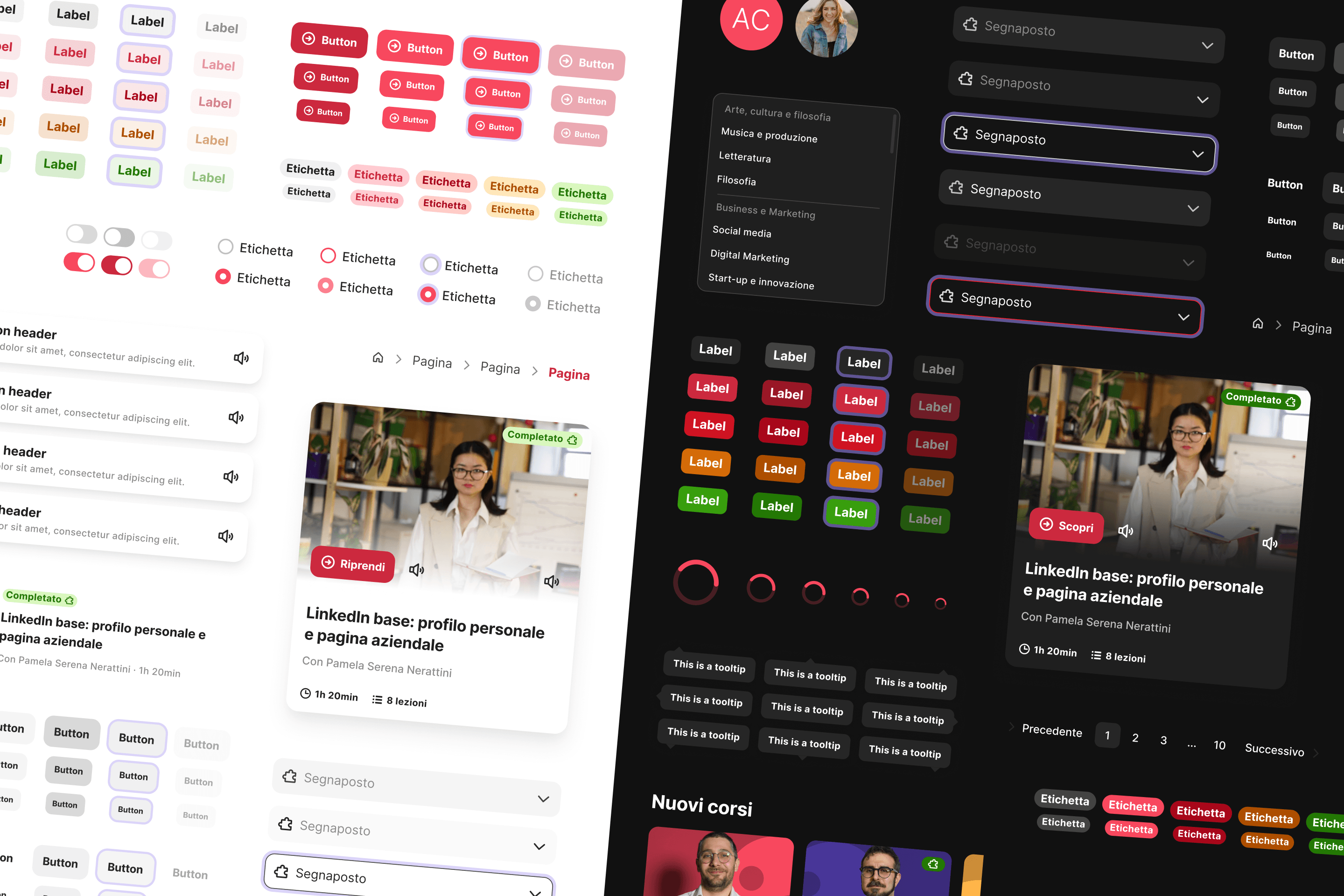
That’s the principle behind the Design Foundation Sprint. Together with the client, we pick an area that is complex and meaningful enough, redesign it in high fidelity, and use that work to define the rules and patterns that can be applied to the rest of the software.
The goal isn’t to produce as many screens as possible, but to make the right decisions. Those decisions shape a design system that is more than a library of buttons: a set of components, patterns and rules that describe how the product should work and what experience it should offer.
The screens we design then become a concrete reference for everything built afterwards, including features nobody can foresee today.
Designing for a world where software is built with AI agents
Another factor shaped this approach deeply.
AI-powered development tools are making interfaces easier and easier to build. A developer can now build in a few hours what used to take days, and AI agents can work directly on the code to create features, update components and change entire flows. The results are often surprising, design included, at least at first glance.
The problem is what we now call AI slop. Dashboards full of unlikely metrics, cards everywhere, decorative charts, colorful badges, and components that all look like they came out of the same generator. Interfaces that work, maybe even better than the old software they replace, but that often add complexity instead of removing it.
Yet design is above all a matter of choices. It means understanding what really matters, building clear information hierarchies, simplifying flows and removing everything that isn’t needed. It also means giving the product a recognizable visual identity, something that sets it apart from the thousands of interfaces generated every day.
We don’t want to give up the speed AI offers. We want to create the conditions to use it better.
That’s why the Design Foundation Sprint doesn’t stop at building the design system in Figma. We also document principles, rules, constraints and anti-patterns in a format AI agents can use during development. That way Claude Code, Cursor or Codex can work within a defined product language, instead of inventing a new one with every prompt.
Of course, a document doesn’t automatically turn an AI agent into a good product designer. But it lets the agent use design decisions already made, existing components and proven patterns, so it doesn’t have to start from scratch every time.
How the Design Foundation Sprint works
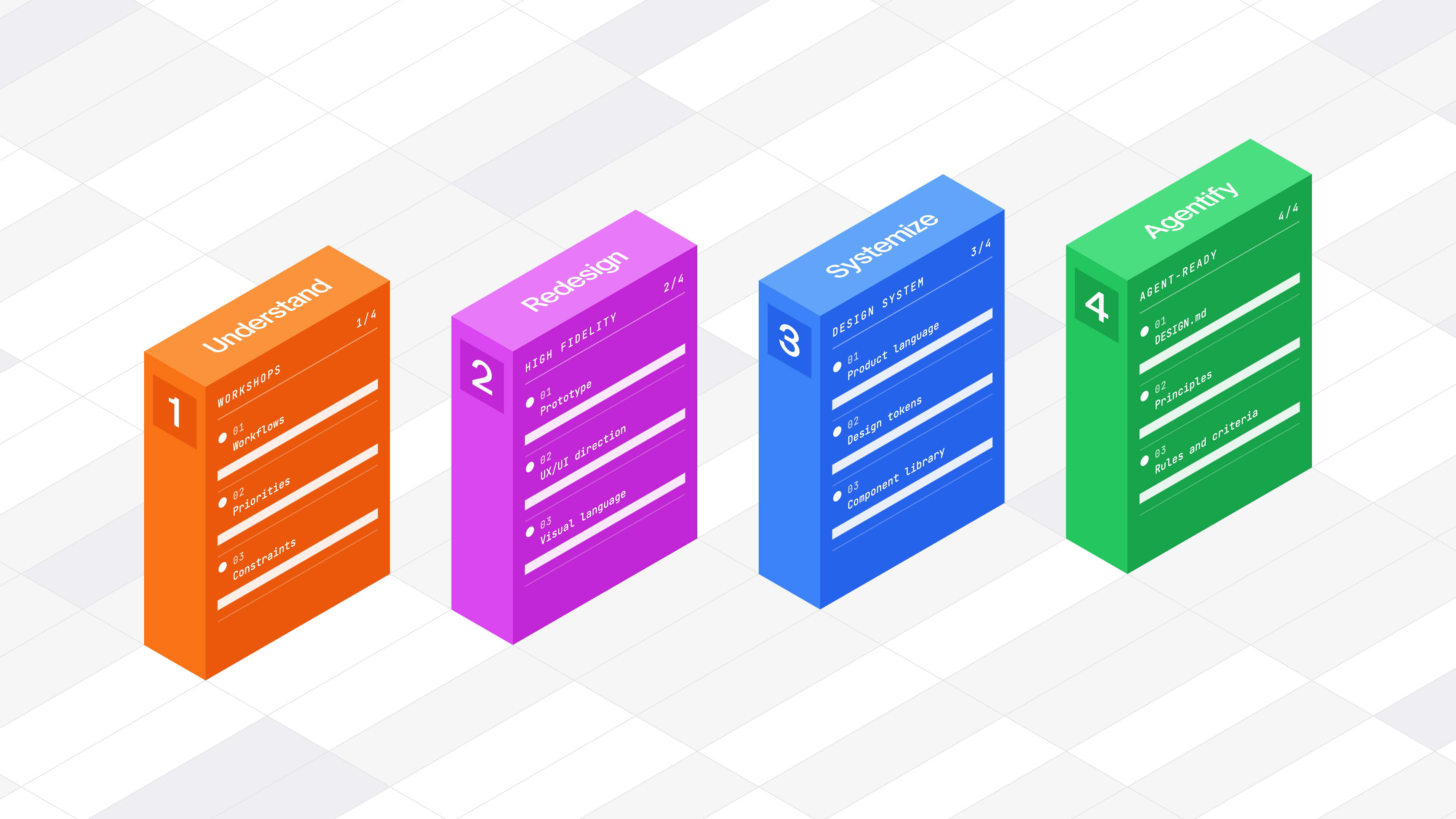
The Design Foundation Sprint lasts six weeks and runs in four phases: Understand, Redesign, Systemize and Agentify. We start by understanding the product and a representative area, redesign it, turn the decisions we made into a system, and document rules and patterns so they can guide designers, developers and AI agents.
At the end, the team has a new UX/UI direction, a high-fidelity prototype, a design system, and documentation to gradually extend the work to the rest of the software.
We don’t deliver a complete redesign. We deliver the tools to carry it out over time, while keeping a consistent direction.
The activities, outputs and organization of the Sprint are all described on the Design Foundation Sprint page.
A new role for a design studio
For a long time, we worked on redesigns organized in successive sprints, gradually designing screens, flows and features. That model still makes sense in many contexts. Meanwhile, though, our clients’ teams have changed: they now build much faster, and the faster you go, the more it matters to know which way you’re heading.
Many companies today want to keep control of their product, make the most of their in-house teams, and make decisions without constantly depending on a vendor. AI has accelerated this shift, making it even more important to separate design work from execution.

We’ve written about this in Does a design studio still make sense? and in our series on enterprise software redesign. With the Design Foundation Sprint, we decided to turn those reflections into a different way of working.
We believe our contribution carries the most weight when it comes early: in the decisions that shape every screen to come, not just the ones we design ourselves. Understanding the problems, making the fundamental choices and building a system that can evolve is the part of the work that multiplies: every decision made well there is repeated across hundreds of screens.
Who it works for, and who it doesn’t
The Design Foundation Sprint is designed mainly for software companies that already have a product and a technical team able to build it.
It can be especially useful when software has grown over the years and needs a new UX/UI direction, during a replatforming, or when the team wants to speed up development with AI agents without compromising design consistency and quality.
It isn’t the right fit for anyone looking for a turnkey product, perhaps starting from scratch and without in-house technical skills. That calls for a different path, one that includes full development and implementation.
Nor does it mean every problem is solved after six weeks. Complex software keeps evolving, new needs emerge, and some decisions will need revisiting. That’s why, after the Sprint, we can keep working with the team in three ways: Agile Design Sprints, two weeks each, to design new areas and features in depth; the Code Foundation, to implement components and patterns directly in the product’s stack; and Design Reviews, to periodically review the work of people and AI agents. They’re all described on the Design Foundation Sprint page.
Each of them starts from a direction that’s already shared: it doesn’t start from scratch, it builds on what the Sprint put in place.
The product is yours. Even after the Sprint
The Design Foundation Sprint is a major change in the way we work, but the goal hasn’t changed: helping companies build better software.
Today we think we can do that by focusing our contribution on the decisions that really matter, and by building the foundations teams can keep working on, with the tools and technologies they prefer.
Whether the next screen is built by an in-house designer, a developer or an AI agent, we want them to start from a clear direction, without having to invent everything from scratch.